2026 Home Security Market Report
 |
April 1, 2026
|
April 1, 2026
Key Findings:
- 61% of U.S. households now have at least one security camera — up from 52% in 2024. Today, about 74.9 million homes have indoor or outdoor security cameras.
- Ring is the dominant home security brand, identified by 43% of users as their primary system or camera brand. 58.9 million Americans own video doorbells like those manufactured by Ring.
- DIY installation has overtaken professional installation for the first time: 49% of alarm system users installed their own systems, compared to 42% who hired a professional.
- Inflation is quietly affecting the market's edges: 12% of users delayed upgrades in the past year due to rising costs, and younger users (18–29) are significantly more likely to have canceled or downgraded subscriptions than older cohorts.
- AI features are gaining traction: 28% of users already have AI person or package detection, and 39% say they want facial recognition — even as concerns about access to footage and surveillance are rising.
- The benefits of home security cameras far outweigh privacy concerns: while 37% worry about who might access their footage, 87% say home security increases their peace of mind.
Home security has quietly crossed a threshold in American life. What was once considered an upgrade for high-crime neighborhoods or high-value homes is now a mainstream household fixture: cameras mounted above garage doors, video doorbells at front entries, smart locks on side gates. Home protection tools have become as common as smoke detectors.
To better understand how Americans are using home security technology today, SafeHome.org surveyed 2,435 U.S. adults about their devices, their motivations, and their concerns. Our findings reveal a market that is larger and more complex than ever: one shaped not just by crime and safety, but by peace of mind, parenting, package theft, and a growing debate about privacy in an era of always-on cameras.
How Common Are Home Security Systems in the U.S.?
Security cameras are now in the majority of American homes. Among the device categories we tracked — cameras, alarm systems, and video doorbells — cameras have seen the most dramatic growth over the past three years. In fact, 74.9 million American households now have either indoor or outdoor security cameras.
Home Security Device Adoption Among All U.S. Households, By Year
| Device type | 2023 | 2024 | 2026 |
|---|---|---|---|
| Home security cameras | 42% | 52% | 61% |
| Video doorbell | 37% | 45% | 48% |
| Home alarm system | 32% | 28% | 30% |
Source: SafeHome.org Annual Home Security Surveys
Home security camera adoption has climbed 19 percentage points over two years, crossing the threshold from a minority to a majority. Video doorbell cameras have followed a similar arc, approaching half of all U.S. households at 48 percent, which equates to 58.9 million homes. Home alarm system use has remained relatively constant over the past three years.
Homeowners continue to lead renters in adoption across all categories, but the gap is narrowing. Among renters, security camera adoption jumped 12 percentage points in a single year, from 42 percent to 54 percent. This is the sharpest single-year gain in the dataset. This likely reflects the mainstream availability of wireless, battery-powered cameras that renters can install temporarily in apartments without landlord permission.
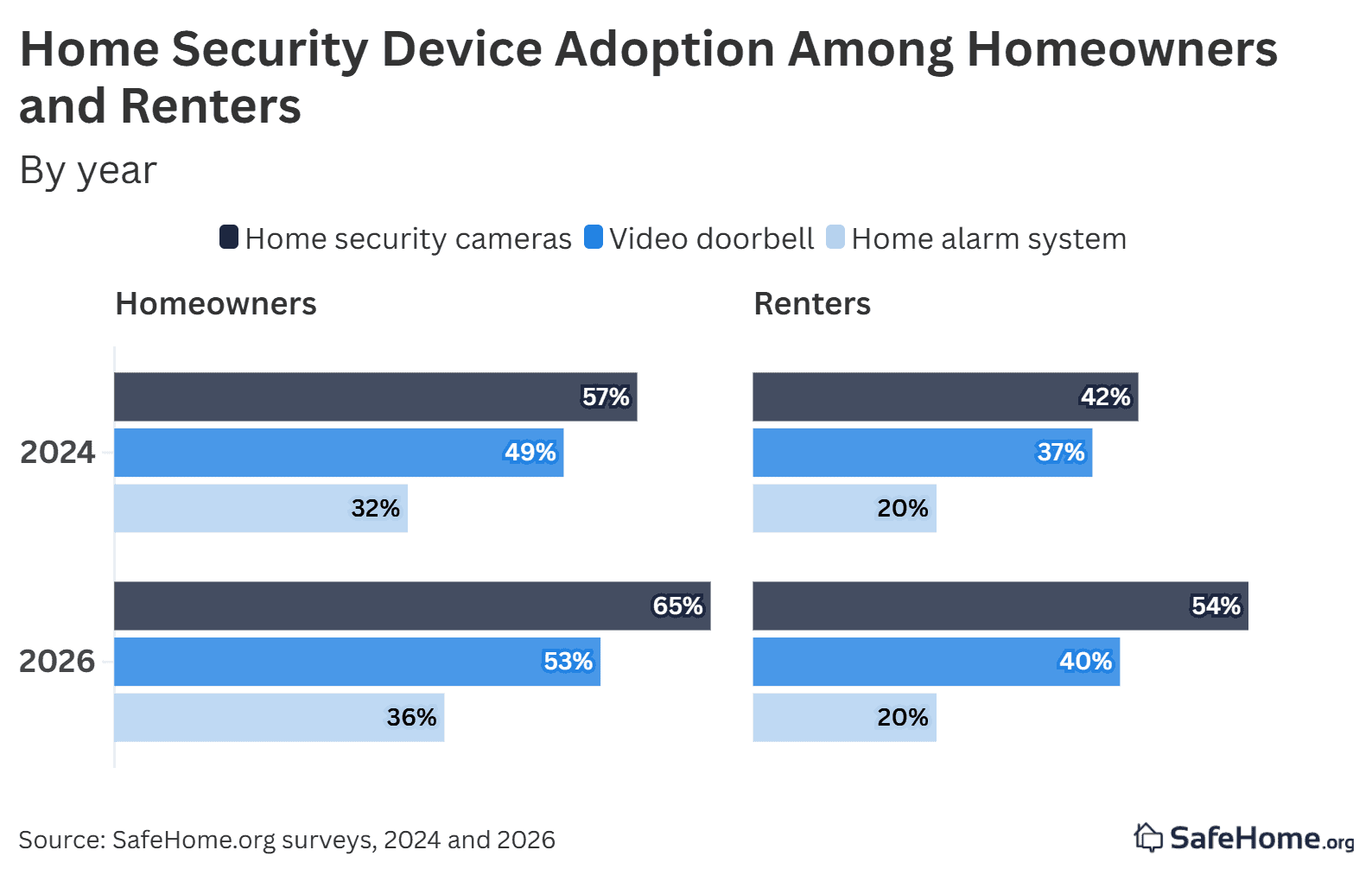 Alarm system adoption among renters has flatlined at 20 percent for two consecutive years, pointing to persistent barriers: lease restrictions, upfront hardware costs, and the complexity of traditional alarm installation. For renters, security cameras offer a flexible, portable alternative to full alarm systems, and the data shows they are taking that option in large numbers.
Notably, six percent of respondents said they stopped using home security devices in the past year, a figure worth watching as cost pressures on subscriptions and monitoring plans continue to build.
Top Home Security Brands in 2026
When we asked Americans which brand best represents their primary home security system or cameras, Ring and ADT emerged with commanding leads. Our analysis included users of doorbell cameras, home security cameras, home security systems, and access control devices.
Home Security Brand Market Share
| Brand | Percent of camera or security system users |
|---|---|
| Ring | 43% |
| ADT | 10% |
| Google Nest | 7% |
| Wyze | 6% |
| Xfinity | 5% |
| SimpliSafe | 5% |
| Eufy | 4% |
| Honeywell | 3% |
| Vivint | 3% |
Source: SafeHome.org survey of 2,435 U.S. adults
Among survey respondents, Ring was the most popular home security camera brand by 43 percent of users — nearly as often as all other brands combined. ADT, despite over 150 years in the industry, follows at 10 percent. Google Nest, Wyze, and Xfinity round out the top five.
Ring's dominance reflects the broader shift toward DIY, app-managed, camera-first security. Its product line (video doorbells, indoor and outdoor cameras, and a stripped-down alarm system) maps directly onto the motivations and purchase priorities consumers report in this survey. Affordable hardware, no long-term contracts, and an intuitive mobile app have brought Ring to a wide range of users, from renters to suburban homeowners.
That market leadership is unfolding against an increasingly complex backdrop. Ring's Search Party feature, launched in late 2025 and prominently featured in a February 2026 ad, uses AI to scan neighboring Ring cameras for missing pets, and generated significant backlash from privacy advocates who raised concerns about opt-out defaults and the potential for broader surveillance use.
Just seven percent of users switched home security providers in the past three years — a low rate that reflects how sticky the category is once hardware is installed. Among those who did switch, the reasons are telling.
Reasons for Switching Home Security Providers
| Reason for switching | Percent of switchers |
|---|---|
| Better features | 48% |
| Lower cost | 39% |
| Easier setup or use | 29% |
| Better customer service | 21% |
| Moved homes | 21% |
| Privacy or data concerns | 12% |
| Contract or cancellation issues | 7% |
Source: SafeHome.org survey of 2,435 U.S. adults
Multiple selections allowed. Base: users who switched providers in the past 3 years.
Better features and lower cost are the top reasons for switching — both attributes that have broadly favored newer, DIY-oriented brands. Notably, 12 percent of switchers cite privacy or data concerns as a reason for leaving their previous provider. Given the volume of privacy-related headlines surrounding the industry's leading brands in 2025 and 2026, that number bears watching in future surveys.
Most Popular Security System Features
Home security users are building increasingly personalized device stacks, mixing cameras, smart sensors, and automation tools into setups that go well beyond a traditional alarm. Our data shows a market in mild consolidation after a period of rapid feature expansion — with some categories pulling back and others quietly gaining ground.
Top Home Security System Features
Percentage of security system owners using each feature, by year
| Feature | 2023 | 2024 | 2026 |
|---|---|---|---|
| Outdoor cameras | — | 63% | 54% |
| Motion sensor lights | 36% | 43% | 41% |
| Floodlights | 37% | 35% | 32% |
| Motion sensors | 26% | 32% | 26% |
| Internal cameras | 24% | 33% | 30% |
| Smart smoke detectors | 23% | 33% | 30% |
| Smart carbon monoxide detectors | 22% | 30% | 29% |
| Smart locks | 14% | 20% | 22% |
| Window open sensors | 16% | 18% | 16% |
| Entryway sensors | 25% | 19% | 14% |
| Glass breaking sensors | 12% | 11% | 9% |
| Key fobs | 10% | 13% | 16% |
| Panic buttons | 8% | 6% | 6% |
| Home automation controls | 8% | 12% | 13% |
| Water/flood detectors | 6% | 8% | 9% |
Source: SafeHome.org surveys. Multiple selections allowed.
Outdoor cameras saw a notable 9-point decline from their 2024 peak, which may reflect some rationalization of camera footprints after years of rapid expansion. Smart locks continued their steady climb to 22 percent usage, key fobs rose to 16 percent, and home automation controls ticked up to 13 percent — all pointing toward deeper integration with whole-home smart ecosystems. Entryway sensors have declined for three straight years, likely displaced by video doorbells that serve the same entry-monitoring function with more utility.
How Households With Children Approach Home Security Differently
The most consistent pattern in the feature data is the gap between households with and without children. Parents build noticeably more comprehensive security stacks across nearly every category.
| Home security devices used | Households without children | Households with children |
|---|---|---|
| Outdoor camera | 49% | 66% |
| Video doorbell | 43% | 60% |
| Motion sensor lights | 38% | 47% |
| Smart locks | 18% | 29% |
| Indoor cameras | 27% | 37% |
| Smart smoke detectors | 27% | 37% |
| Alarm (with professional monitoring) | 14% | 20% |
| Alarm (without professional monitoring) | 12% | 23% |
| Smart carbon monoxide detectors | 28% | 32% |
| Motion sensors | 23% | 31% |
| Floodlights | 31% | 35% |
| Window open sensors | 14% | 20% |
| Glass breaking sensors | 8% | 12% |
| Water/flood detectors | 8% | 11% |
| None of the above | 12% | 6% |
Source: SafeHome.org survey of 2,435 U.S. adults. Multiple selections allowed.
The gaps are most pronounced for video doorbells (+17 points), outdoor cameras (+17 points), and smart locks (+11 points), devices that monitor who is coming and going. For families, home security is less a single product purchase and more a layered system built around monitoring entry points, protecting children, and maintaining awareness when parents are away.
AI-Enabled Security Features
AI is no longer a future-facing concept in home security. It has arrived in mainstream devices, and consumer appetite for more is high.
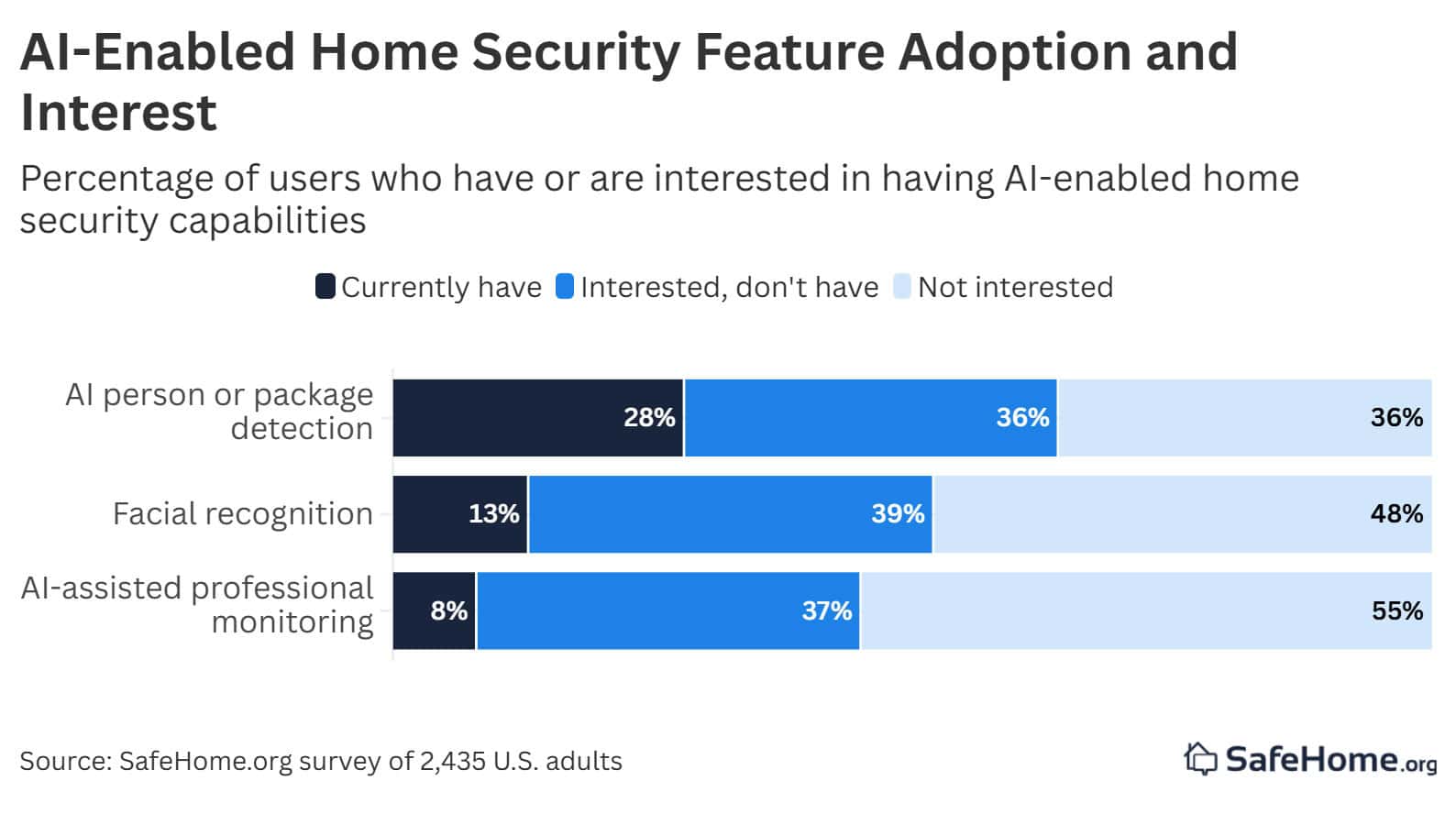 AI person and package detection has reached meaningful adoption at 28 percent, largely driven by Ring, Nest, and Eufy devices that ship with these features as defaults. Facial recognition has lower current adoption (13 percent) but very high latent interest (39 percent) — suggesting it is on a short path to mainstream use. AI-assisted professional monitoring is the least-adopted category but shows strong interest among a third of users.
How Consumers Choose Home Security Systems
Understanding what consumers actually prioritize when buying tells a clear story: today's home security shopper is pragmatic, self-sufficient, and largely unimpressed by the features the industry once led with.
Most Important Factors When Choosing Home Security Products
| Factor | All users |
|---|---|
| Ease of use | 50% |
| Monthly cost | 46% |
| Ease of self-installation | 31% |
| Brand reputation | 25% |
| Upfront equipment cost | 24% |
| No long-term contract | 22% |
| App quality | 23% |
| Privacy protections | 16% |
| Professional monitoring | 14% |
| Integration with smart devices | 14% |
| Recommendations from others | 12% |
| Professional install option | 6% |
Source: SafeHome.org survey of 2,435 U.S. adults. Up to three selections allowed.
Ease of use was the top decision-making factor for 50 percent of users, followed closely by monthly cost at 46 percent. Ease of self-installation ranks third at 31 percent. These three factors together describe the essential value proposition of the DIY home security market and help explain why brands like Ring have risen so quickly against incumbents.
How Alarm Systems Are Installed
For the first time in our tracking, more home alarm system users are installing their own systems than hiring professionals: 49 percent installed their current home alarm systems.
| Is your home security alarm self-installed or professionally installed? | Percentage of users |
|---|---|
| I installed it myself | 49% |
| It was professionally installed | 42% |
| It was already installed when I moved in | 8% |
| I'm not sure | 1% |
Source: SafeHome.org survey of 2,435 U.S. adults
Self-installation has edged out professional installation, a reversal with real implications for how the industry operates. The shift is most pronounced among younger users: 54 percent of 18–29-year-olds and 55 percent of 30–44-year-olds installed their own systems, compared to 38 percent of those 60 and older. DIY has become the default for a generation of buyers who are comfortable setting up connected devices themselves and prefer to avoid the cost and scheduling friction of professional installation.
Video Storage: Privacy Issues and How Users Want Their Footage Saved
How a camera stores footage — whether on a local device, in the cloud, or both — depends on the brand, the plan, and the level of control the user wants over their data. Nearly half of security camera or doorbell camera users (49 percent) prefer a hybrid cloud-and-local storage approach. This is a more sophisticated preference that reflects growing awareness of the trade-offs of each option. The 19 percent of users who prefer local-only storage likely includes privacy-conscious users wary of cloud data access, as well as users of brands like Eufy, Reolink, and TP-Link that offer subscription-free local recording built into their devices.
Video Storage Preferences Among Home Security Camera Users, 2026
| Storage type in current home security camera | Percent of users |
|---|---|
| A mix of cloud and local storage | 49% |
| Cloud storage only | 32% |
| Local storage only (SD card, NVR, NAS) | 19% |
Source: SafeHome.org survey of 2,435 U.S. adults.
The 32 percent who rely solely on cloud storage are dependent on an active paid subscription to retain recorded footage. Major platforms, including Ring, Blink, and Nest, require a paid plan to store video; without one, only a live feed is accessible, and footage is overwritten when motion is detected. This limitation received significant public attention in early 2026 following a high-profile missing-person case in Arizona, in which a doorbell camera detected motion the night of the incident but had no active subscription to preserve the footage. The FBI ultimately recovered residual data from backend servers through an extraordinary forensic process — a capability that may not be available to ordinary consumers reviewing footage after the fact.
That case also illustrates a tension running through the home security market more broadly: the same footage that users want preserved in a crisis is the same footage they may not want stored at all under other circumstances. How and where video is saved is inseparable from who can access it, and our survey finds that concern is already widespread.
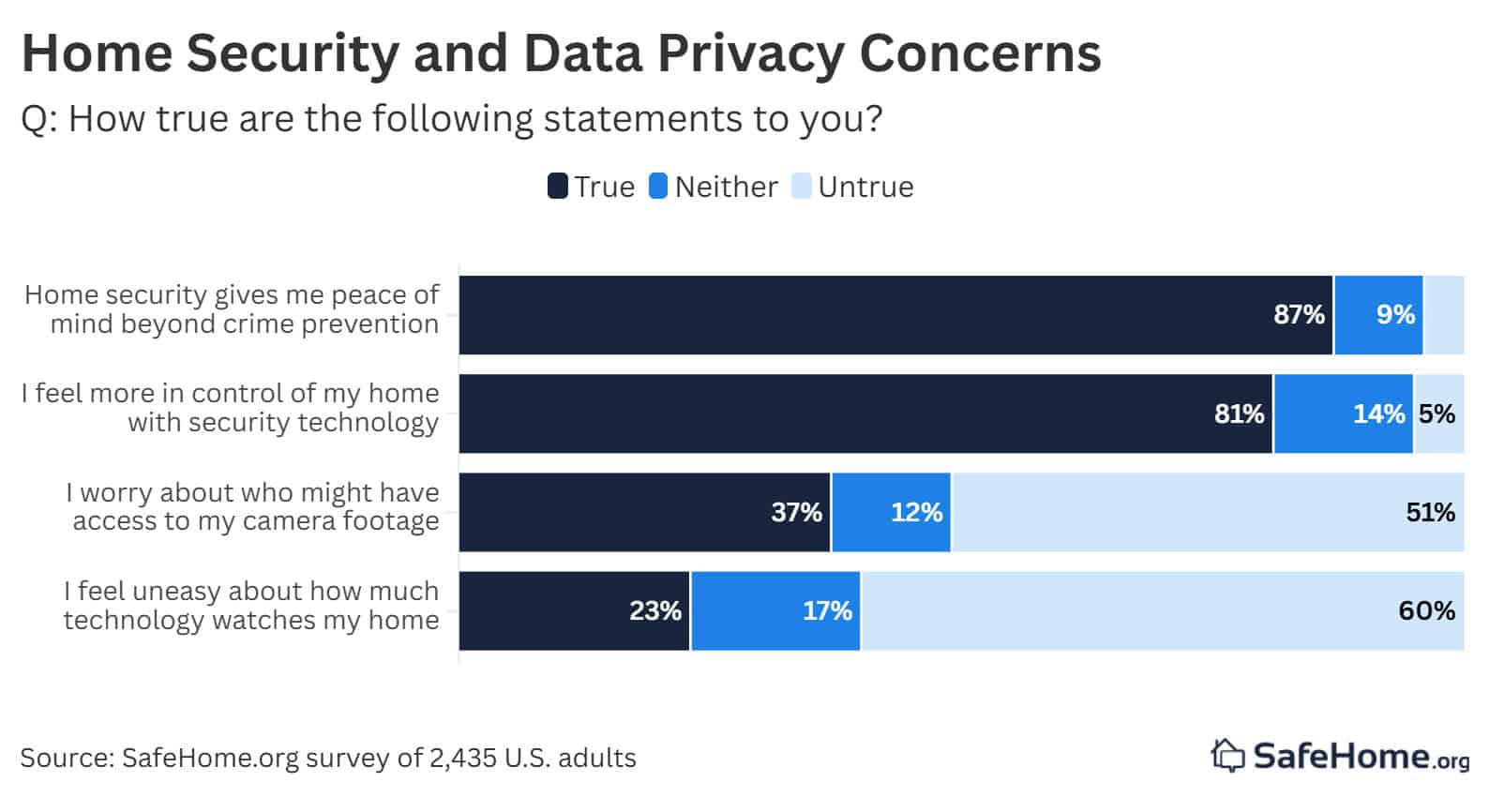 The dominant experience of home security is overwhelmingly positive: 87 percent find peace of mind that extends beyond crime prevention, and 81 percent feel more in control of their homes. But 37 percent of users worry about who might have access to their footage, and 23 percent feel uneasy about how much technology watches their home. These are not fringe positions — they represent a substantial share of an already large user base, and they are likely to grow.
How Inflation Is Affecting Home Security Decisions
For the first time in the history of our security system market research, we asked users directly whether rising everyday costs have affected their home security decisions. The majority say no, but the minority who say yes are concentrated in ways that matter.
| In the past 12 months, have rising everyday costs affected how you manage home security products or services? | Homeowners | Renters | All users |
|---|---|---|---|
| No, rising costs have not affected my decisions | 65% | 54% | 62% |
| I delayed upgrading or adding new devices | 10% | 16% | 12% |
| I considered canceling, but decided not to | 7% | 9% | 8% |
| I reduced the number of paid features or add-ons | 6% | 11% | 7% |
| I chose lower-cost products than originally planned | 6% | 9% | 7% |
| I canceled or downgraded a subscription | 5% | 8% | 6% |
| N/A — I don't pay for home security products or services | 9% | 8% | 9% |
Source: SafeHome.org survey of 2,435 U.S. adults. Multiple selections allowed.
More than 60 percent of users say cost pressures have not changed their home security decisions. Among the 38 percent who have been impacted by rising costs, renters are disproportionately affected: 16 percent delayed upgrades, 11 percent reduced paid features, and eight percent canceled or downgraded subscriptions entirely.
Taken together, the cumulative effects of delaying, downgrading, trading down, and canceling represent real erosion at the cost-sensitive edges of the market, even if the headline number looks stable.
Younger users show the sharpest effects. Users aged 18–29 were significantly more likely than those 60 and older to have reduced paid features, canceled or downgraded a subscription, or considered canceling.
Home Security Market Outlook for 2026
Overall, the home security device market has reached broad adoption and is now deepening as users add features, change brands, and navigate new questions about what home security technology actually means for the people who use it.
Home Security Purchase Intentions in the Next 12 Months Among Non-Users
| Which of these home security devices do you plan to add or upgrade in the next 12 months? | Homeowners | Renters | All non-users |
|---|---|---|---|
| Security cameras | 28% | 30% | 28% |
| Video doorbells | 19% | 27% | 22% |
| Home alarm system | 10% | 14% | 11% |
| Access control system | 7% | 8% | 7% |
| Professional monitoring | 5% | 4% | 5% |
| None of the above | 54% | 48% | 52% |
Source: SafeHome.org survey of 2,435 U.S. adults. Multiple selections allowed.
Among non-users, security cameras are most appealing. Twenty-eight percent of non-users are interested in buying them in the next year. Renters who don’t currently use home security devices had notably higher interest in doorbells. This is consistent with a renter market that is growing despite traditional barriers, such as lease restrictions and installation costs. Just five percent of non-users were interested in professional monitoring services in the next 12 months, suggesting most new market entrants will opt for self-managed devices rather than monitored accounts.
Several broader security trends are worth watching over the next few months:
- DIY tools have become the default, but may have a ceiling. With 49 percent of alarm users installing the systems themselves and professional monitoring ranking 9th among 12 purchase factors, the industry has fundamentally shifted toward consumer-managed security. The open question is whether self-installed, unmonitored systems are providing the protection users expect, particularly for the cost-sensitive cohort that has recently canceled subscriptions.
- Renters represent a fast-growing segment. A 12-point jump in renter camera adoption in one year, combined with purchase intent higher than homeowners' across most device categories, points to renters as the most dynamic growth opportunity in the market. Products designed specifically for renters (cable-free installation, portable hardware, no-contract plans) are well-positioned to capture this demand.
- AI is moving from a futuristic feature to a baseline expectation. With 28 percent of home security device users already running AI person and package detection, and 39 percent interested in facial recognition features, AI is on a fast path to becoming a standard capability rather than a premium add-on. The major brands are already pricing these features into their base hardware. What remains to be defined is the data and privacy framework that governs them.
- The subscription gap is a real and growing vulnerability. 32 percent of users rely on cloud-only storage for their security camera footage, and six percent canceled or downgraded paid plans in the past year. For these users, a camera that detects motion but cannot record it offers a false sense of security. As awareness of this limitation grows and as brands offer subscription-free local storage options, this will become a more prominent competitive battleground.
Methodology
This study is based on a nationally representative online survey of 2,435 U.S. adults conducted from January 29 to February 11, 2026. The survey examined how Americans protect their homes, evaluate home security brands and features, and view issues such as AI integration, subscription costs, privacy, and consumer trust.
Participants were U.S. residents age 18 and older recruited through a reputable online research platform using quota sampling to match 2020 U.S. Census benchmarks for age, gender, and race. Because the sample was designed to align with national demographics during recruitment, no post-collection weighting was applied.
Data were collected through a structured online questionnaire including multiple-choice, multi-select, and Likert-scale questions about home security adoption, motivations, features, privacy attitudes, and purchasing behavior. Only fully completed responses were included in the final dataset.
With a sample of 2,435 respondents, the survey has an approximate margin of error of ±2 percentage points at the 95% confidence level for results based on the full sample.